


Videoart at Midnight 159#: Driant Zeneli, Eintritt gratis! Free entry!
How do we push the boundaries of our limitations without becoming superheroes? Can the realm of the possible be balanced with the one of the imaginary?
The redefinition of the idea of failure, utopia, and dream stands at the core of Zeneli’s research, as elements that open up possible alternatives. In his films, and video sculpture installations the representation of power, science, ecology and mythology. The fairy tales are interlaced with individual narratives, giving rise to utopias that subvert the natural order of things. The creative act feeds on unplanned encounters and the relationship with the architectural heritage of places.
Zeneli uses his films as a material to sculpt place and time. The performances take the form of participatory interventions, during which the artist con-creates the meaning of the work with the spectators. The element of gravity resonates throughout the artistic production, be it films, drawings, or happenings, in a constant attempt to detach himself from the earth, to play with his own limits.
Since 2008, this artist has launched an art education project dedicated to the relationship between practice and pedagogical research, an investigation into the relationship between creation and education that intends to experiment with alternative practices to those carried out by public institutions. From time to time, the artist creates workshops for children focused on storytelling and uses tools such as electronics and robotics to understand our actions and boost our imagination.
Driant Zeneli, who is present, shows:
Some Say the Moon is Easy to Touch…, 2011, 5:15 min
What is the most seductive promise of happiness hidden behind a general sense of disillusionment? This is the question posed by the trilogy “When Dreams Become Necessity” (2009–2014), which examines the significance of specific performative undertakings aimed at redefining the concepts of failure, utopia and dreams as fundamental elements for the creation of a possible alternative. In three performative actions, the artist attempts to achieve goals that are generally considered impossible. Anticipation and technical preparations take up practically the entire duration of each video, culminating in the rapid attainment of the goal and the subsequent shattering of the illusion. In “Some Say the Moon is Easy to Touch…” (2011), the artist performs a bungee jump in an attempt to touch the moon on the day it is closest to Earth. The imagination is neither exhausted by personal failure nor impoverished by the setbacks of science; rather, it embraces the challenges and opens itself up to reflection and research that can transform the promise into a commitment.
Maybe the Cosmos is not so Extraordinary, 2019, 10:23 min
The multidisciplinary project “Beneath a Surface There is Just Another Surface”, launched in 2015 at Metallurgjik, a dystopian industrial complex in the Albanian city of Elbasan, takes its title from the seminal science fiction novel “On the Way to Epsilon Eridani” (1983) by the Albanian physicist and writer Arion Hysenbegas. The film, based on this project, is set in the mines of Bulqize, a town in the north-east of the country where chromium ore has been mined since 1918. Chromium is a key resource for Albania’s industrial development and lies at the heart of economic and political conflicts in the Global South. The film depicts a group of teenagers discovering a cosmic capsule which follows the journey of chrome, from its extraction and processing within the factory to its exportation and worldwide exploitation. This “geopolitical” space travel therefore turns this shady and dramatic industrial environment into an ambivalent space for collapse and takeoff. A drone escorts the characters throughout the space travel, whereas the crossed echo of the voices of Bujar and Flora, the two protagonists, resonates from above. Quoting Hysenbegas’ scientific and literary tale, they breathe a parallel rhythm into the film narrative. Through binary storytelling and precise choreography of image and sound, the factory operates not only as an industrial space or geopolitical hub but as a visually performative force. The extraction of chrome is turned into a hypnotic sculptural image and the overall factory therefore translates into a big light and sound “parallel” installation, organically plugged into the walls of Arsenale. In this productive and immersive space, Driant Zeneli intends to create tension between an oppressive underground reality and a utopian space of possibility and liberation.
Maybe the cosmos is not so extraordinary and tries to physically reveal the ability of the ordinary, even in its darkest corners, to expand our existence.
How Deep Can a Dragonfly Swim Under the Ocean?, 2021, 11:23 min
The story of a dragonfly that, despite being able to move its wings, is condemned to never fly, thus failing to get away from the ocean, is the second chapter of the trilogy „The Animals. Once Upon a time… in the present time“ (2019-2022). The dragonfly, a symbol of spiritual depth, power, change of perspective, and adaptation recalls the real experience of Rilond Risto, who spent 21 years of isolation in Albanian prisons, creating mechanical insects capable of flying from various circumstantial tools during his last period of imprisonment. The dragonfly moves inside the Pyramid of Tirana, a memorial monument to the Albanian dictator Enver Hoxha built in the late 1980s. Since the 90s this building has experienced different moments of transformation while having different functions. It is currently being repurposed to become a new hub for Tirana. Among the architecture of the brutalist monument, the dragonfly feeds on the fossil of an octopus in order to survive, but at the same time, it is held by it without the possibility to fly and get away from the Pyramid. The artist uses this image as a metaphor for the perennial man’s attempt to detach himself from a context imposed by society.
The Firefly Keeps Falling and the Snake Keeps Growing, 2022, 11:46 min
inspired by an ancient fable, the third chapter of the trilogy „The Animals. Once Upon a Time … in a present Time“ (2019–2022), was filmed at Skopje’s Central Post Office, one of the most emblematic brutalist buildings in the Balkans. Built in 1974, the structure was ravaged after a fire outbreak and UNESCO now considers it as one of the 7 most endangered buildings in the world. Developed in a collaborative process that is integral to the artist’s practice, this film was conceived and created with the students of the Faculty of Mechanical Engineering, Ss. Cyril and Methodius University in Skopje, North Macedonia.
Those Who Tried to Put the Rainbow Back in the Sky, 2012, 7:50 min
Three people and a duck that, being on a ship of concrete in a wait condition, accidentally find a piece of rainbow fallen from the sky. In doubt about the origin and the destiny of the rainbow, they decide to put the rainbow back in the sky. As in ancient Greek theatrical representations of tragedies, everything in this video takes place in one day which also coincides with the real length of the video shoots. However, is impossible to decipher the historical time, as it is rather a “lived time” which allow us to reflect only upon the final act that dramatically suspends any judgment and brings every thought back to its origin.
The film was made in Albania in a small village called Velmisht. Passing by, the artist discovered a boat made of cement, and met who built it: Pellumb’s desire, an Albanian who emigrated to Greece for many years, where he worked at the port of Athens. His dream was to return to his native land and build a big ship.
When winds in Monsoon play, the White Peacock will sweep away, 2025, 20:21 min
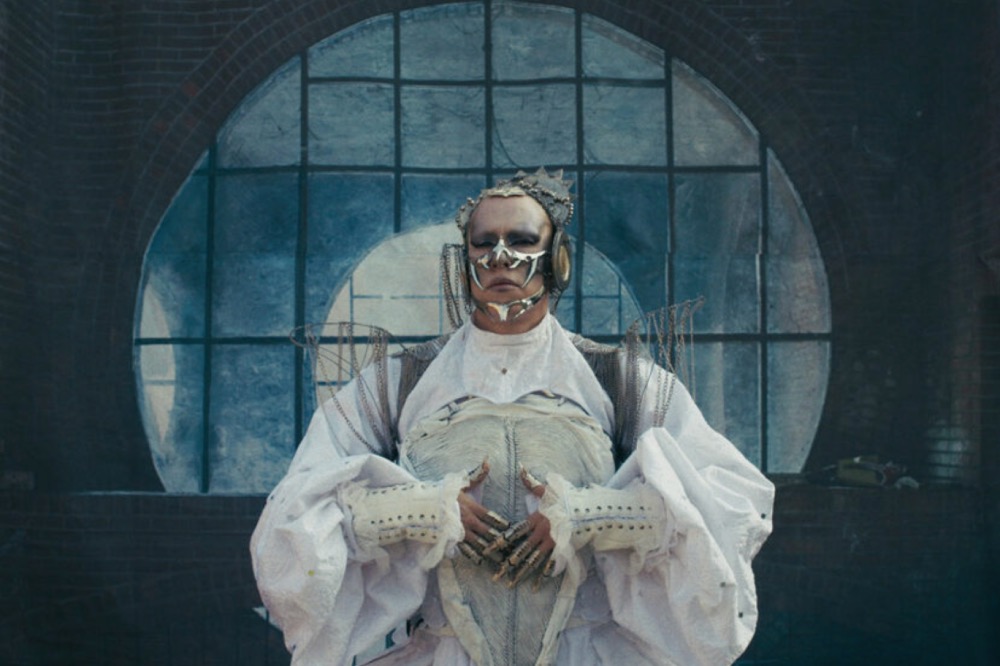
Driant Zeneli’s new opera-film, set within the Parliament of Dhaka and the Srihatta Art Centre in Sylhet (Bangladesh), unfolds as an allegorical fable featuring a white peacock that falls in love with his own tear. The story, paced by the six seasons of the Bengali calendar, guides us through multiple layers of interpretation, addressing political, ecological, and existential themes. Zeneli reflects on the tensions between the fall, power and love, giving shape to a form of magical realism in which utopias subvert the natural order of things and open up unconventional imaginative spaces. The extraordinary brutalist architecture designed by Louis Kahn becomes an integral part of the narration, both as a physical and metaphorical presence. The film’s voice-over draws inspiration from the Khonar Bachan, ancient proverbs from the Bengali oral tradition associated with Khona, a legendary astrologer and poet. The project is distinguished by the active involvement of young artists in Bangladesh, who contributed to the development of the narrative and the visual elements of the work. The soundtrack reinterprets baroque compositions in a contemporary key, merging them with musical traditions from Bengali culture into an original and hybrid score.
All Art Has Been …Temporary, 2008, 2:30 min
Featuring a neon installation by Italian artist Maurizio Nannucci, a glowing phrase is placed on the rooftop of the Gallery of Modern and Contemporary Art in Turin stating: ALL ART HAS BEEN TEMPORARY. For few days three letters of the neon sign failed to light up, changing completely the sense of the original statement. The video documents the temporality of the situation, thus reflecting upon the notion of contemporaneity not only as an artistic practice but also as a technical and socio-political construction.
Driant Zeneli (b. 1983 in Shkoder, Albania) lives between Tirana and Turin. He graduated at the Academy of Fine Arts in Macerata, Italy. 2001 – 2005 BA: Sculpting, and 2006 – 2008 MFA: Multimedia.
Among his solo shows are the National Gallery, Sofia, 2026; MSU, Museum of Contemporary Art Zagreb, 2025; National Gallery of North Ma Macedonia, 2022: National Gallery of The Republic of Kosovo, Prishtina (2019); Albanian Pavilion 58th International Art Exhibition – Venice Biennale, (2019); GAMEC, Museum of Modern and Contemporary Art, Bergamo, (2019); Villa Medici, Rome (2016); GAM, Museum of Modern and Contemporary Art Turin (2013)
Among his group shows are the Kochi Muziris Biennale 6th, Kochi, (2026); EMST, National Museum of Contemporary Art, Athens,(2025); Sharjah Biennial 16, (2025); 15th Bienal De La Habana, (2024); Ruhr Triennale, Bochum (2024); Kiran Nadar Museum of Art (KNMA), New Delhi, (2024); Maxxi Museum, Rome (2023); Double Feature – Schirn Kunsthalle Frankfurt (2023); Dhaka Art Summit (DAS), Dhaka (2023); 59th October Salon, Belgrade Biennale,(2022); Manifesta Biennial 14, Prishtina (2022); Teatrino Palazzo Grassi, Venice, (2021); 39th EVA International Biennial, Limerick (2020); Latvian Centre for Contemporary Art, Riga (2019); Albanian Pavilion 54th International Art Exhibition – Venice Biennale, (2019); Autostrada Biennale, Prizren, (2019); Mostyn Gallery, Wales, UK (2017); MuCEM, Marseille, (2016) Centre Pompidou, Paris (2016); ZKM, Karlsruhe (2012); MUSAC, Castilla León. Spain, (2012); Prague Biennale 5 (2011); National Gallery of Albania, Tirana (2008).
pic: When winds in Monsoon play, the White Peacock will sweep away, 2025, 4k video, 20:01 min. Courtesy of the Artist. The film was done in collaboration with Md. Tasnimul Izaz Bhuiyan, Pulak K. Sarkar, Rafi Nur Hamid, Sondip Roy, Sumaiya Sultana, with the special contribution of Mahmudul Hasan Dipu.